

Bow legs and knock knees in children
8-minute read
Key facts
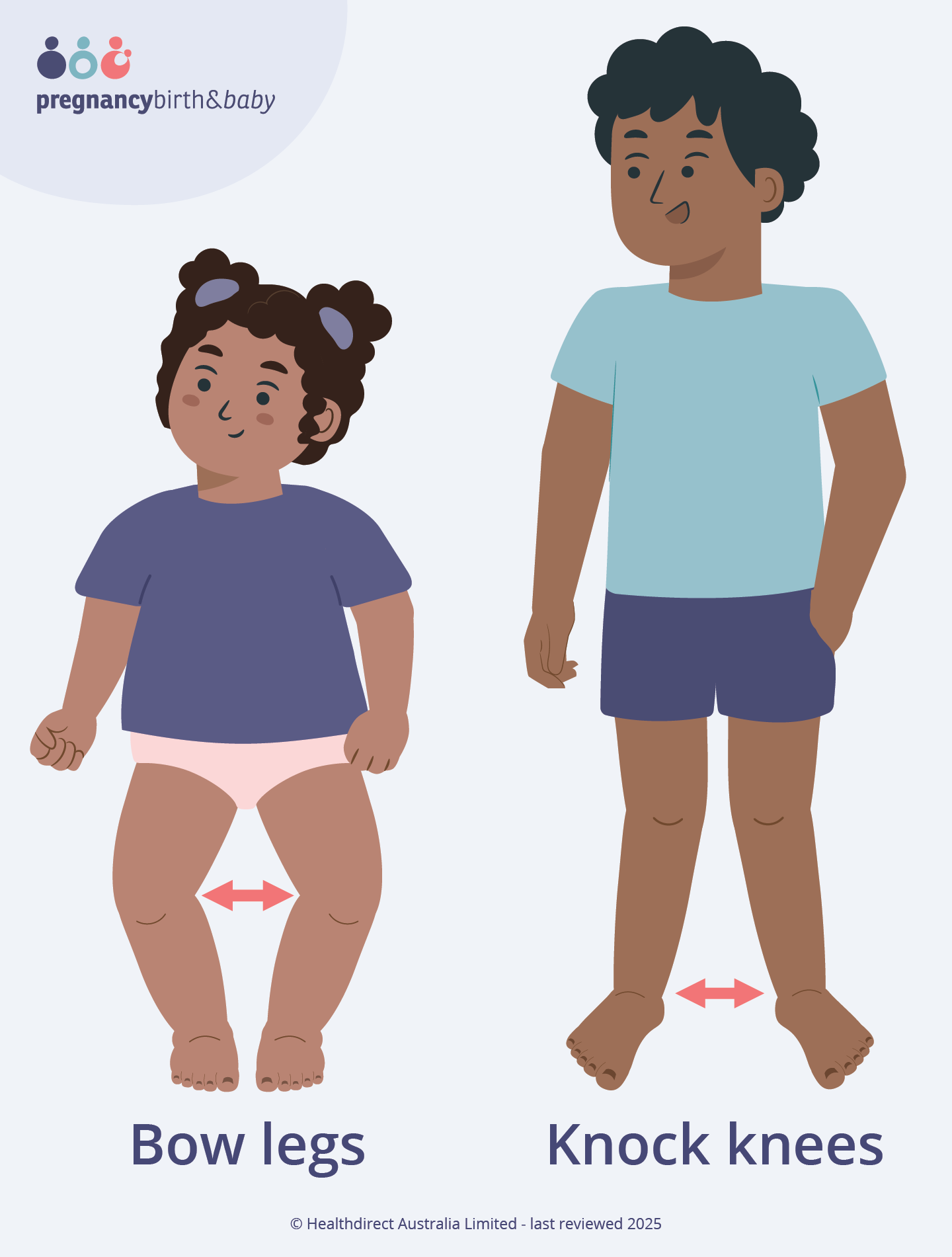
- Your child has bow legs if their ankles are close together but their knees are wide apart when they are standing.
- Your child has knock knees if their knees are close together but not their ankles when they are standing.
- Knock knees and bow legs are usually a normal part of a child’s growth and development.
- Sometimes they can be caused by an underlying medical condition.
- Often they don’t need any treatment and will improve over time.
What are bow legs and knock knees?
Very young children often have knees and legs that look a bit awkward. Bow legs and knock knees are common. Both conditions are part of normal development and usually disappear as your child grows.
What are bow legs?
Your child has bow legs if their ankles are close together but their knees are wide apart when standing. The medical term for bow legs is genu varum.
Many babies have bow legs at birth. It may become more obvious once they start crawling or walking.
Most children will outgrow their bow legs by 3 years of age.
What are knock knees?
Your child has knock knees if their knees are close together but their ankles are wide apart when standing. The medical term for knock knees is genu valgum.
Parents often first notice their child has knock knees around 2 to 3 years of age. Your child will usually outgrow knock knees by 8 years of age.
Some children will have knock knees until they are teenagers or even adults.
What causes bow legs and knock knees?
Knock knees and bow legs are usually a normal part of your child’s growth and development. Many children are born with bow legs, and their knees will then become straight at around 2 years of age. They may then develop knock knees at around 3 years of age. Most children’s legs then become straight again by 8 years of age.
This is a normal process.
Bow legs and knock knees can be caused by a medical condition, but this is rare.
If your child’s bow legs or knock knees are caused by a medical condition, you may notice:
- the bow legs are severe and not resolved by 3 years of age
- the knock knee angle is large and continues to get larger after 8 years of age
- it occurs on only one leg
- it causes pain or a limp
- your child is particularly short for their age
Medical causes of bow legs
Some medical conditions that can cause bow legs include:
- rickets — a bone condition caused by not having enough Vitamin D or calcium
- Blount’s disease — a problem with the growth plate in the shin bone
- a previous illness that has affected your child’s growth
Medical causes of knock knees
Some medical conditions that can cause knock knees include:
- rickets — a bone condition caused by not having enough Vitamin D or calcium
- a previous fracture in the area
- hip dysplasia — when the hip joint doesn’t develop properly
- a metabolic bone disorder
When should I see my doctor?
In most cases your child will outgrow bow legs and knock knees without treatment.
See your doctor if:
- the condition is severe
- your child still has bow legs after 3 years of age
- knock knees get worse after 8 years of age
- one leg is worse than the other
- your child is in pain or limping
- your child is short for their age
If you are worried about your child’s condition see your doctor for advice.
FIND A HEALTH SERVICE — The Service Finder can help you find doctors, pharmacies, hospitals and other health services.
How are bow legs and knock knees diagnosed?
Your doctor can diagnose bow legs and knock knees. Your doctor will examine your child’s legs and watch their walking pattern.
Your doctor may recommend further tests such as an x-ray or a blood test, but this is not always needed.
How are bowlegs and knock knees treated?
Most children with bow legs and knock knees do not need treatment. They will usually grow out of the condition with time. Braces or special shoes do not help make bow legs or knock knees straight.
If your child’s knock knees or bow legs are due to an underlying medical problem, the medical problem may need to be treated.
Some children with knock knees may need surgery to help correct their knee alignment. This is rare and is only needed if your child is in pain or has difficulty walking.
Can bow legs and knock knees be prevented?
Bow legs and knock knees are a normal part of development in babies and children and cannot be prevented.
Resources and support
Talk to your doctor or child health nurse if you have questions about bow legs and knock knees in children.
The Sydney Children’s Hospital Network website has a fact sheet on bow legs and knock knees in children.

Speak to a maternal child health nurse
Call Pregnancy, Birth and Baby to speak to a maternal child health nurse on 1800 882 436 or video call. Available 7am to midnight (AET), 7 days a week.
Learn more here about the development and quality assurance of healthdirect content.
Last reviewed: August 2025